Sunday, February 7, 2010

The resurection of the electric dream

The EV or Electric vehicle program was started to comply with the Zero Emissions Act in California in order to reduce smog. The act stated in a nutshell that if car manufacturers wanted to continue selling cars in California, they had to create a car that produced zero emissions. Thus the Electric car was born.

GM was the first company to create a zero emissions car. It came out of the division of GM known as Saturn in 1997. The cars were leased and there were long waiting lists if you wanted one, though according to GM there was no demand for them. Zippy little cars, the EV1s were fast, affordable, and there was very little to maintain. The oil companies were infuriated by the electric car that didn't need oil or gasoline to run. Secretly they bought that patent for the battery that ran the EVs. GM did its part to help the oil companies by dismantling the program and recalling its fleet of EVs without any apparent reason. EV owners were infuriated, they tried everything in order to keep their cars to no prevail. GM claimed that they would donate the cars to museums and universities, and that their engineers would be driving them in order to gather valuable information about them.

There is one EV1 left today in an auto museum, all of its technology has been destroyed.

The oil companies think they won.


........But they are so wrong.
I became interested in EV technology after seeing the movie made about GM and their EV called Who Killed the Electric car? A car that is silent, doesn't produce carbon emissions, and is sleek and sexy, who wouldn't want that?

Recently I was researching cars and came across a car called the Nissan Leaf.
Curious of the name I googled it and low and behold this is what i found.
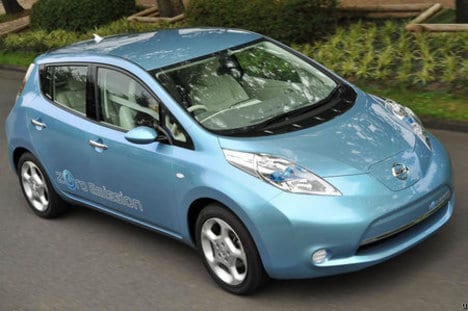
The Nissan leaf is a new breed of EV technology. The oil companies thought they had killed the electric car, but 7 years later we find that people still have a need for it. A want for it.

The Nissan motor group has been developing the technology necessary to create a fully functional electric car. They developed a lithium ion battery, small and condensed, that carries twice the power of any car battery.

Okay so now you ask yourself how much does it cost to charge this battery?

Lets say that the average cost to fill up your gas tank is about $40-$70 depending on the type of car you have.
The national average is $0.1147/kWh. That means the average cost to charge the car would be $2.75 from 0% to 100%.
So the most you'd spend in a month is around $85 with the Nissan Leaf.
Your gas car? between $148 and $300

Next your probably wondering how long will it stay charged for? The Leaf holds a charge for around 100 miles depending on weather, driving habits, and driving conditions.

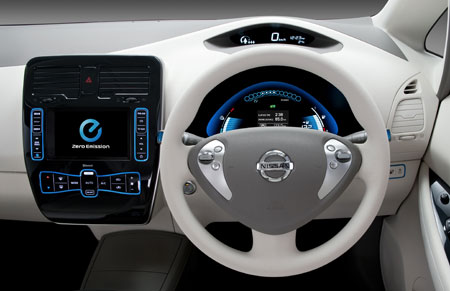
The interior of the leaf resembles that of a space ship. It looks like it came out of Star Trek.


The cost of this car will probably be around the same price as any family sedan.


Zero emissions. That is the future of cars.

Monday, December 21, 2009

The House that Joseph Built?

Nazareth, the town the bible tells us, where the archangel Gabriel came to the Virgin Mary and informed her she was with child, the son of God to be exact. Archaeologists, after finding a tomb that dates to the time of Jesus Christ, have discovered an ancient dwelling which they say also dates back to the time of Jesus. They found remains of a wall, a hideout, a courtyard and a water system that appeared to collect water from the roof and supply it to the home. The discovery was made when builders dug up the courtyard of a former convent to make room for a new Christian center, just yards (meters) away from the Basilica.

According to the Associated Press "This may well have been a place that Jesus and his contemporaries were familiar with," archaeologist Yardena Alexandre said. A young Jesus may have played around the house with his cousins and friends, she said. "It's a logical suggestion." Alexandre also told the Associated Press that her team also found a camouflaged entry way into a grotto, which she believes was used by Jews at the time to hide from Roman soldiers who were battling Jewish rebels at the time for control of the area.

“The grotto would have hid around six people for a few hours,” she said.
However, Roman soldiers did not end up battling Nazareth's Jews because the hamlet had little strategic value at the time.

“The Roman army was more interested in larger towns and strategic hilltop communities, “she said.

Alexandre also told the AP that similar camouflaged grottos have been found in other ancient Jewish communities of the lower Galilee such as the nearby biblical village of Cana, which did witness battle between Jews and Romans.

Nazareth in Jesus’ time was probably home to no more than 50 people but the modern day city is home to more than 65,000 people. With such a densely populated area, it is very unlikely that there will be any more excavations. The discoveries of the Jesus era house and tombs are the only clues of what daily life was like in Nazareth during the boyhood of Jesus Christ

The ancient tomb found still had the remains of a man inside. In Israel if a tomb is discovered, the body must be re-buried in 48 hours. Archaeologists did this but not before taking a few hundred samples from the body. Forensic specialists have discovered that the man found had leprosy, which as history tells us was very common during this time period. The discovery that the man had leprosy also backs up a story from the bible in which Jesus Christ encounters a man with leprosy.

As I see it, this discovery only answers a few questions, leaving many unanswered. Hopefully as time goes on we will learn more about the man known as Jesus Christ and the time period he lived in.

(cited from-Hadid, Diaa. "First house from Jesus' time found in Nazareth." The Associated Press. Nazareth, Israel , 21 December 2009.)

The Fight for Auschwitz

A scar on the face of humanity, the imposing structure of Auschwitz has been a preserved as a tribute to the 1.1 million people who were murdered there. The Auschwitz complex made up of Auschwitz and Auschwitz II (more commonly referred to as Birkenau) has been a museum since 1947 and after seven decades of exposure to the elements this complex of death is disappearing into the pages of history.

The museum site includes over 300 ruins, 155 buildings, and 191 hectares of land. The cost of preserving the Auschwitz museum, as stated by museum officials, is somewhere around $100 million dollars, which is $90 million more than the museums annual budget. A 92 year old survivor of the concentration camp, Kalman Sultanik, who is also the treasurer of the museums budget, has been quoted by the BBC saying that the international community, more so Germany, has not done enough for the survivors of Auschwitz and the complex itself.

Officials of the museum are hoping to set up a $170 million dollar endowment fund with the help of the international community in order to save the museum for future generations as a reminder that there are truly evil people in the world.

There are some, however, who believe that we should simply leave Auschwitz and Birkenau to the roots and brambles and allow them to simply be erased as if they had ceased to exist at all. Wladyslaw Bartoszewski, the chairman of the International Auschwitz council and former prisoner, number 4427, commented on the importance of saving Auschwitz to the BBC,

“But the moment when there will be no more eyewitnesses left is inexorably approaching. What remains is that when the people are gone “the stones will cry out". The ruins of the crematoria and gas chambers in Birkenau, the empty bunks in barracks, the dark cells in Block 11 and the wall of death- all of them will cry out. If we let the memorial cease to exist, we will take a great burden on our conscience- we will trample upon the testament of the victims.”

The complex of Auschwitz-Birkenau offers a pang of remorse to those people who are indifferent to the suffering of others. Auschwitz-Birkenau should not be forgotten. It should not be left to the roots and brambles; it should not be allowed to rot away because like Bartoszewski said when all of the survivors have gone the walls and buildings and grounds still tell their stories.